How can you remember phrasal verbs and use them when you speak? Start with a short story. You probably know get and up. But then you meet get up, give up and put up with. Why do they mean different things? English can feel a little unfair. Don’t worry. Today, we will start with one ordinary morning.
First, a joke about an alarm clock
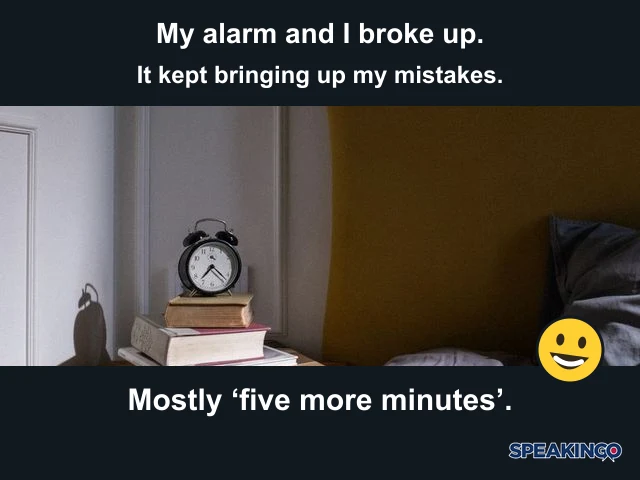
Look at the picture:
My alarm and I broke up. It kept bringing up my mistakes. Mostly ‘five more minutes’.
Let’s unpack the joke. When two people break up, they end their relationship. When someone brings up a subject, they start talking about it. In this joke, the alarm clock is like a partner who keeps reminding you of your mistakes. You say “five more minutes”, but you still do not get out of bed. Of course, a clock cannot argue with you. It can only ring. Sometimes that is quite enough!
Notice that up does not have the same meaning in both expressions. Learn the whole expression, not just the little word at the end.
Remember phrasal verbs with a morning story
Read this aloud and picture each action:
I wake up at seven, but I don’t get up straight away. I turn off the alarm, put on a jumper and head out.
Here are the five expressions:
- wake up: you stop sleeping and become awake.
- get up: you leave your bed. You can be awake and still be in bed!
- turn off: you stop a machine or device from working. Here, you stop the alarm.
- put on: you move clothes onto your body. A jumper is a sweater.
- head out: you leave a place, often to go somewhere. It is a natural, informal expression.
Straight away means immediately. So our speaker wakes up at seven, stays in bed for a little while, switches off the alarm, gets dressed and leaves.
Stories help you connect words with a situation. Clear meanings matter too. In a study published by Cambridge University Press, learners reading short texts learned figurative phrasal verbs better when definitions were available. Making the expressions bold also helped. That is why this lesson gives you a story, simple explanations and a practice activity.
Now imagine this: you wake up at seven, but you get up at eight. There is no grammar problem. Your boss may see a different problem.
Where does “it” go? Turn it off
These two sentences are both correct:
I turn off the alarm.
I turn the alarm off.
They mean the same thing. Here, turn off is separable: you can put the noun between the two parts. But what happens when you replace the alarm with it?
Say: I turn it off.
Do not say: I turn off it.
The same pattern works with clothes: I put on my jumper or I put my jumper on, but I put it on.
This rule applies to these separable phrasal verbs. Other phrasal verbs work differently, so check each new expression.
Your turn: say the morning in your own words
Cover the answers. Complete each sentence with the expression you need. Say the whole sentence aloud.
- I stop sleeping at eight. I ___ at eight.
- I stay in bed for a while. I don’t ___ straight away.
- The alarm is ringing. I ___ it ___.
- My jumper is on the chair. I ___ it ___.
- I leave home at nine. I ___ at nine.
Possible answers:
- I wake up at eight.
- I don’t get up straight away.
- I turn it off.
- I put it on.
- I head out at nine.
Now change the times and the clothes. Tell your own morning story. If you work at home, perhaps you do not head out at all. That is fine. A story about your real life is more useful than a sentence you only repeat.
A list is a starting point. Speaking is the next step
Choose a few useful expressions. Make a small scene about shopping, travelling or talking at work. Later, try to tell it again without looking. Recognising a word on a page and finding it yourself in a conversation are different tasks. Give yourself practice with both.
Here is today’s question: What time do you wake up — and what time do you actually get up?
Practise phrasal verbs in conversation with SPEAKINGO
Use the expressions in practice on SPEAKINGO. In the lessons, you listen to questions and answer aloud in full sentences. This gives you practice in listening, remembering words and speaking for yourself.
You talk to your computer or phone. Speech recognition checks your answers. You can work at your own pace and return to sentences that you find difficult. After signing in, look for the additional learning materials, including complete lessons with hundreds of common phrasal verbs.
Create an account using the form below and try learning through conversation with SPEAKINGO. Practise now, then tell someone about your morning. Your alarm can wait another five minutes. Your English does not have to!