What are English articles?
English articles have no direct equivalent in Polish. They are small words that do not really carry meaning on their own, and we put them before nouns. There are four possibilities here: a, an, the, or … nothing. Polish does not have this exact system, or at least not in the same way.
Why?
Because in Polish we sometimes say “this”, “that”, or “it” to show gender or the type of thing we are talking about. But English does not have grammatical gender for nouns like that. That is really good news. So let us start with the good news: what we do not have to learn.
Great! English does not have grammatical gender!
It may seem that articles are just another way English makes life difficult. Quite the opposite!
In English, objects do not have grammatical gender. The same things often have different genders in different languages.
For example, “the English language” is feminine in German: die Englische Sprache. And a girl is das Mädchen, which is not “the girl” but literally “the thing girl”. That makes learning such a foreign language much harder, because everything gets mixed up. Frustrated learners of German sometimes joke that if it were not for der-die-das, Germans would be from us — and there are also den, dem and des!
There is nothing like that in English. What a relief!
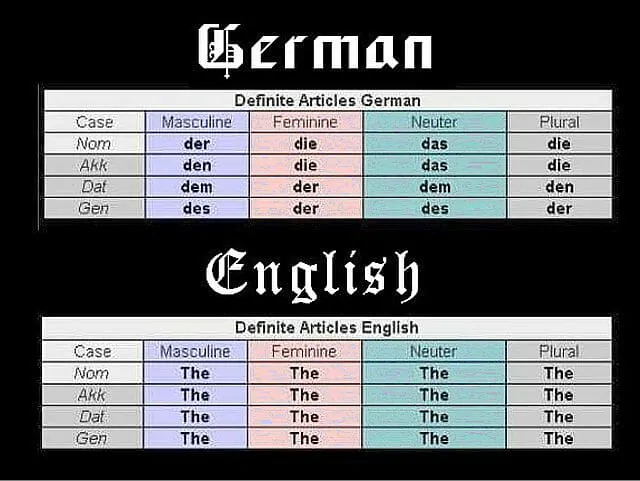
So there are no grammatical genders in English. Of course, there are personal pronouns (he, she, they, etc.), but that is a different story.
The 4 English articles
After that introduction, we can move on to the English articles from the title.
There are only a few English articles, and in fact we have only four options:
- a
- an
- the
- or… nothing.

When do we use the English articles a an?
If we see something for the first time, we use a.
- a dog
- a cat
- a house
There are a few exceptions to this general rule.
For example, if a word starts with a vowel sound, it would sound strange to say it with just a. So egg would not sound right as aaeegg. To make pronunciation easier, we add n to a, and that gives us an:
- an egg
- an ice cream
- an orange
An article with an adjective
The same rule applies if an adjective comes between the article and the noun. Then only the first letter after the article matters.
It may sound complicated, but it is easy in practice. For example, if we want to say that a job is interesting, we say:
a job → an interesting job
a cat → an unusual cat

a before words starting with u
Interestingly, English speakers do not treat u as a vowel in every case, because in the English alphabet it is pronounced as /ju/.
That is why they call it a “semi-vowel”. So before words starting with u, we use a, for example:
- a university
- a ukulele
We also do this before the two-vowel spelling eu, which is also pronounced like “ju”.
- a eucalyptus tree
Exceptions to exceptions in English
Following that line of thought, we reach one of the famous “exceptions to exceptions” in English grammar. In the case of our “unusual cat”, we do not pronounce the u in the prefix un- as “ju” anymore (as in “ju-niversity”), but as “an” (“an-ju-ual”) 🙂
- an unusual cat
So we have the famous exceptions to exceptions in learning English! 🙂
[Rule: Before vowels we use an. Exception: unless it is the letter u, then we use a. Exception to the exception: unless it is a word like unusual, then we use an…]
a before a silent h
On the other hand, in words that start with the consonant h but have a silent h (it is not pronounced), we use an:
- an hour
- an herb garden
- an honour

When do we use the?
If we hear about something again, we use the.
That is the general rule…
This is a car. The car is fast.
We also use the when there is only one thing of that kind, for example the Moon and the Sun always take the — at least in our solar system.
Likewise, if there is only one thing of that kind in our context, we also use the. If we are in a room, there is only one ceiling there, so we say the ceiling.
Or if we want to talk to the manager of a shop — and we assume there is only one manager — we say:
- Can I speak to the manager, please?
(I would like to speak to the manager.)
So do English articles mean anything?
Psychologists did an experiment. In the same situation, they asked people:
- Have you seen a car light?
and a second group of people:
- Have you seen the car light?
It turned out that although the situation changed only by the article — both groups saw the same thing, only the question was phrased differently — the group with a light saw it less often than the group with the light.
This is because a is general and not very specific, while the refers to things we already know, things that are specific or unique. So the suggested to the participants that they had seen something.
So perhaps the meaning of these sentences would be better translated as:
- Have you seen a car light?
(Have you seen any car lights?)
and the second group:
- Have you seen the car light?
(Have you seen those car lights?)

When can we leave articles out without any problem?
In general, we can leave articles out in the plural form (this is called “zero article”):
These are girls. I like cars.
(These are girls. I like cars.)
However, if — just like in the singular example above — we mean a specific group of people or objects, we can show that with the.
- Let’s talk to the girls who smile at us.
(There are many girls around, but we are going to talk to the ones who smile at us.)
There are also a few common cases — exceptions — where we leave articles out:
- before sports: I play basketball.
- before school subjects: I like Maths.
- before languages: She speaks Polish.
- before cities: I live in Wrocław.
- before countries: She comes from Ireland.
- before names: I saw Queen Elizabeth yesterday!
- before meals: I had breakfast. Let’s go for lunch.
- before outer space: He never flew in space again.
When must we always use the?
As I mentioned, when there is only one of something in the world — the Sun — we always need the definite article the before it.
If something is “the most” or “the best”, then it is also only one — because there is only one number one. That is why we always use the: the most beautiful, the ugliest.
We can say that places are also unique. And although, as we have already seen, we leave out the before cities and countries, in most other geographical nouns we do need the. Especially if the place is wet:
- before river names: I live by the Odra river.
- before seas, bays and oceans: The Baltic Sea. The Gulf of Mexico. The Atlantic Ocean.
- but also before deserts: The Sahara Desert
- and forests: The Amazon forest
- and cultural places: the cinema, the theatre, the radio, the TV.
Another point is that we always use the article before jobs:
- an engineer
- a doctor
- a teacher
Here we can absolutely use the if we mean a specific person who does that job:
- Have you seen the teacher?
(Have you seen the teacher? — That specific one who has class with us today.)
We use the same logic to describe what kind of person someone is — again with an article:
- He’s an optimist.
(He is an optimist.)
- She’s such a bore.
(She is so boring.)
Articles and pronouns
The articles a, an, the and possessive adjectives (my, your, her) do not go well together. And because the possessive adjectives are stronger, they “eat” the English articles.
So:
This is a book → This is my book.
That’s the problem → That’s her problem.
(We do not say That’s her the problem.)
And that is all on this complicated-sounding topic.
If you are just starting your English journey, this is already more than enough information for the first time. The important thing is to practise a, an and the in real sentences — and you can do that on the Speakingo course!
If you are curious or already know some English, you can add more knowledge about articles with a few more details.

We also leave articles out before uncountable nouns
Things get tricky when we introduce countable and uncountable nouns. As the name says, countable nouns are things we can count. For example one cat, two cats, three cats.
Uncountable nouns are things we cannot count, for example water, beer, happiness.
In our context, it works like this:
Everything above applies to countable nouns (that is, most cases).
More precisely, we treat them as if they were plural.
Before uncountable nouns, we use nothing at all.
For example:
- May you have happiness in your life.
- I drank beer all night.
However, if we hear I want to have a beer, that is not a mistake. Here the speaker means a bottle of beer or a glass of beer, and both bottles and glasses are countable.
In practice, instead of an article we use some:
- Give me water. → Give me some water.
- Give me water sounds as if we wanted all the water in the world. It sounds almost philosophical. Or as if we owned a hydroelectric power station on a dried-up river.
And note this: for some reason, as an exception, money is uncountable!
- Earn some money!
As we saw with “normal”, countable nouns in the plural, if we mean specific things, we can show that with the. The same applies to uncountable nouns — above we spoke about money in general. But if we mean specific money, we can mark that with the:
- He will never give me back the money he owes me…
(He will never give me back the money he owes me…)
You will probably make the most mistakes here, because we do not always know whether a word is countable or uncountable in English.

a as “once in a while”
When something happens regularly from time to time, we also use a structure with a:
- I go to the pub once a month.
(I go to the pub once a month.)
- Take these pills twice a day.
(Take these pills twice a day.)
- These oranges are $2 a kilo.
(These oranges cost two dollars a kilo.)
At school or at the school?
If we mean school as an institution, we say at school (without an article):
- Children need to go to school.
(Children need to go to school.)
If we mean a specific school, we can use the:
- I will go to the school to talk to her teacher.
(I will go to that specific school, for example my daughter’s school, to talk to her teacher.)
The same works with institutions like hospital, university, church or prison.
And one last thing:
What is the difference between a walk and to walk?
In English, we often cannot tell a verb from a noun or an adjective just by looking at the word. The form can be exactly the same.
That is why in a dictionary we put an article before nouns to make things clear (a, an, the).
For example, if we want to tell the difference between the verb to walk and the noun a walk:
Before verbs, for clarity, we add to.
For example:
- to be, to run, to learn.
But
- a run / the run
In the same way, without an article the word French means French (an adjective), while with the French it means the French people (a noun).

Difficult points with the articles a an the
As usual, the devil is in the details. In practice, if you ask an English speaker to correct a text or an essay, every person will correct the articles a, an and the a little differently.
English has much more freedom and much less strict grammar here. Of course, there are general rules like the ones above, but this is definitely not something that should keep us awake at night!

Exercises with the articles a an the
The most important thing is to build the habit of speaking, of course best by repeating correct sentences on the Speakingo online English course 🙂
There you learn all the grammar and vocabulary you need, just like a child. You simply talk to the computer in correct sentences, and it praises you or corrects you when needed.
Thanks to that, over time you stop thinking about which article a, an or the (or maybe none?) to use — you just speak correctly and that is it!
Anyway, the best thing is to simply try the Speakingo online English course! You get 7 days of fun for free, with no obligations! You also get a free level test, access to online dictation, and a PDF list of the 2000 most important English words.
Want to understand English speakers? Start speaking like them!
Sign up for the Speakingo online English course!
If anything about English articles a, an and the (or no article) is still unclear, please ask in the comments. I will be happy to answer!