What are English personal pronouns?
Personal pronouns are short words we use instead of a person’s name.
There are several kinds of pronouns, and here we will explain them in a simple way, without going too deep into grammar terms.
I also talk about this on YouTube:
Personal pronouns in English in the singular are:
-
I, me
-
you
-
he
-
she
-
it
We call he, she, and it the third person singular, which is important in the present simple.
And the personal pronouns for the plural are:
-
we
-
you
-
they
Notice that in English, you means both “you” and “you all”.

Confusion with the English pronoun you
As you have probably noticed, you means both singular and plural. This is a constant source of confusion, because when someone says “You are great!” you never know whether they mean one specific person or everyone present.
What is more, as we may remember from the post about articles, English does not have articles for gender in the same way some other languages do, so the sentence above does not show whether it means a woman or a man. In practice, though, this is good news, because we do not have to learn complicated declension rules.
Now let’s go step by step.

Who am I? The English pronoun “I” or “me”?
In general, “I” means I.
I is always written with a capital letter, because, of course, we are the centre of the world — or at least most people, not only English speakers, think that way about themselves!
To make things a little more complicated, there is also the word me, which also means me.
In English, I is used at the beginning of a sentence,
while me is used in the middle or at the end of a sentence.
For example:
- I am happy.
I am happy.
- Do you love me?
Do you love me?
- Where are you taking me?
Where are you taking me?
In English, we do not leave out personal pronouns!
As I mentioned, personal pronouns are the kind of pronouns that replace a person’s name. In English, they are very important because we use them in every sentence.
In Polish, people often leave them out. In English, we cannot do that.
For example, in Polish you can leave out the pronoun “I”:
- Jestem głodny – I am hungry.
In English, there is only one natural option: I am hungry.
The same is true for the other personal pronouns:
- Jesteś / Jesteście spóźnieni! – You are late!
- Masz / Macie rację… – You are right!
- Mamy dużo bagaży. – We have a lot of luggage.
In short:
In English, we cannot leave out personal pronouns,
as we often do in Polish.

When are English personal pronouns necessary?
English personal pronouns are especially useful when we meet people from other countries and cannot understand their names, for example Mihaly Csikszentmihalyi.
Even when someone spells their name letter by letter, it can still be impossible to remember. Then we simply say you, although remembering the name always looks better. Still, we do what is possible…
The good news is that you is not only “you”, but also “sir” or “ma’am”!
So you can use this pronoun for everyone!
Interestingly, once a difficult name or surname gets into our head, it often stays there for a long time. This is what happens if we introduce ourselves to English speakers using our real names instead of their English equivalents!
And if you forget not only the name, but also the correct English pronoun, you can always say something poetic like my friend or darling, and so on.
Object pronouns in English
All right. But what if we want to give something to someone?
Then we use the rather scary-sounding object pronouns.
Singular object pronouns:
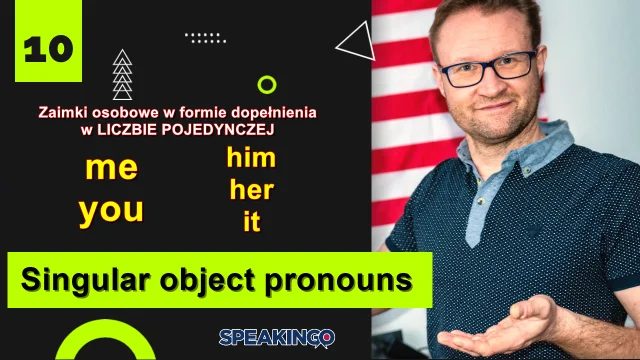
- Jane looked at me. (Jane looked at me.)
- Jane looked at you. (Jane looked at you.)
- Jane looked at him. (Jane looked at him.)
- Jane looked at her. (Jane looked at her.)
- Jane looked at it. (Jane looked at it.)
Plural object pronouns:
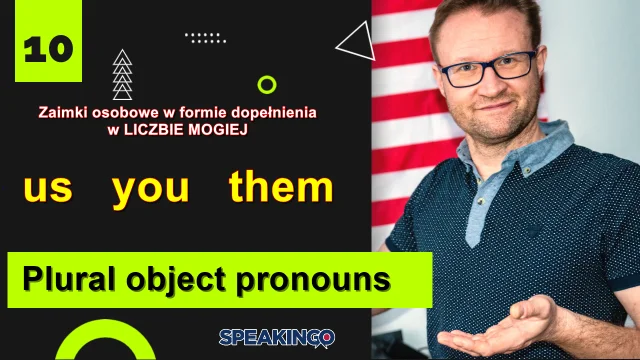
- Jane looked at us. (Jane looked at us.)
- Jane looked at you. (Jane looked at you.)
- Jane looked at them. (Jane looked at them.)
It would be the same in sentences like:
- I gave it to them. (I gave it to them.)
- I love you. (I love you.)
- Please marry me. (Please marry me.)
- Help her! (Help her!)
- Wait for him! (Wait for him!)
And so on.
Although, as you can see, personal pronouns are quite simple, that is not the end of the story.
What if something is “his” or “hers”?
Then we must use not a personal pronoun, but a possessive adjective (for example her house, his phone), which is often confused with the similarly looking possessive pronoun (This is mine!). But we will talk about those in separate posts.

The twilight of personal pronouns?
Finally, as a little curiosity, it is worth mentioning that personal pronouns are going out of fashion at Western universities, where politically correct etiquette encourages the use of the gender-neutral Chinese pronoun xe (pronounced like “ze” or “zi”) so that no one’s gender identity is imposed on them…
Forgot how to say he or she in English? Or not sure whether to say he or she? Say xe!
Another trick is to use they for one person when you do not want to impose a gender identity.
- Customer will choose the option they will find most interesting.
The customer will choose the option that they find most interesting.

Read also: Is there still freedom of speech at English universities?
Exercises with English personal pronouns
One thing is to know all the grammar names for pronouns, and another is to use them correctly in real conversation. Here you need speaking practice; no textbook will do that for you!
To speak English, you have to start speaking English!
That is why, if you really want to learn English, a good amount of conversation is unavoidable. But that is not a problem, even if you are learning on your own at home, because there is a great app for learning to speak English, and only one click separates you from signing up for this phenomenal online English course 🙂
On the Speakingo course, you learn by talking… with a computer that understands what you say, praises you or corrects you, and never loses patience!
It is not only a fast and effective method of learning English online, but also an enjoyable one!
So register with two clicks below and try it free for one week, with no obligation, to see whether you like this way of learning English!
Sign up for the Speakingo online English course!
Want to understand English speakers? Start speaking like them!
Have you ever confused English personal pronouns and called a man “ma’am” or the other way round? Share your stories in the comments!