Hard Times for Free Thinkers at British and American Universities
Although even in the United Kingdom, which is known for freedom of speech, people were allowed to say a great deal, inciting violence in Hyde Park could always get a speaker into trouble. But there is a difference between inciting violence and hatred, and offering healthy criticism or different opinions, and that difference seems to be fading, especially at American and British universities.
Research carried out by the free-speech monitoring organisation Spiked showed that two-thirds of student societies, and one in four university authorities, had censored speakers or refused to allow them to present uncomfortable views at their university. For example, the student society at Oxford University banned the magazine No offence, which was devoted to free speech. The University of East Anglia banned the handing out of sombreros in a restaurant because it might offend Mexicans. You can expect a ban if you support Israel rather than Palestinians, read the wrong newspapers, or strongly oppose abortion. On only three English universities is what is actually illegal banned.
One problem that is often discussed in Poland, but whose scale in the West is hard to grasp, is so-called “political correctness”. It is a modern form of Orwellian newspeak that makes it difficult to talk about facts for fear of offending someone’s feelings. A noble idea in its intention, “English politeness” has now taken on the grotesque shape of the “emperor’s new clothes” from Andersen’s famous fairy tale.

English Fashion from American Universities
The situation seems even harder at American universities, where apparently nothing is tolerated except politically correct orthodoxy. The University of California, Berkeley, which became famous in 1964 for fighting for free speech and for ending the ban on expressing political opinions on university campuses, recently gained world fame again, this time because of riots meant to limit that free speech, which they managed to do.
What is funniest is that masked, far-left students smashed windows in protest against the “racist, homophobic fascist” Milo Yiannopoulos, who… is gay himself and has a Black boyfriend. If you listen to his statements on YouTube, he really does criticise Islam, the left, and militant feminists sharply, but with substance and with a brilliant sense of humour. It is hard, however, to find anything in his cutting remarks that even comes close to inciting hatred or violence — the very violence that his politically correct censors committed during riots supposedly carried out “for a good cause.”

Many universities there have so-called “safe spaces”, where sensitive students from the “snowflake” generation can hide if the fact that someone thinks differently hurts them. And when someone offends a snowflake’s feelings, they start setting cars on fire.
The latest trend from Canada is pressure to use gender-neutral “xe” or “ze” instead of politically incorrect personal pronouns he, she, it, so as not to offend the feelings of people who have not made up their minds on the matter.
Professor Nicholas Christakis also got a rough time — American students surrounded him and booed him because… his wife said that banning costumes at Halloween was crazy. “Universities used to be a safe place not only for growing up, but also for gaining regressive or transgressive experiences,” his wife complained. “Today, more and more, they are becoming a place of censorship and bans.”
The situation is so serious that special organisations defending free speech on campuses have started to appear. One of them is the Foundation for Individual Rights in Education, FIRE. In the video report below, they examine the situation at Tufts University (in English for advanced students):
Exotic Romance
One of the stranger features of the modern political scene in the West is the left’s romance with a religion dominated by conservatives, among whom Father Rydzyk is the most liberal hippie in the world. The biggest offence at a British or American university today is an accusation of so-called Islamophobia. Criticising Christians and Jews is OK, making fun of Mormons is allowed as much as you like, but stay away from the Quran. This leads to tragicomic paradoxes, which are clearly shown by a discussion between two women. Guess which one had a rough time at the hands of academia.
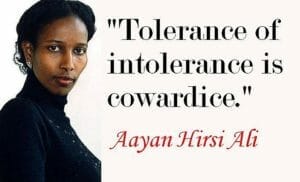
Ayaan Hirsi Ali is Somali by birth, and she fights for the rights of women who are subjected to female genital mutilation, both in Africa and among immigrants from countries where this barbaric practice is carried out. She escaped an arranged marriage to the Netherlands, where she was elected to parliament. She left Islam and, together with the director Theo Van Gogh, made a film calling for reform within that religion. Soon after that, the relative of the great painter was murdered by an Islamist, who, in addition to a knife, left a note on his body saying that she would be next.
On the other hand, we have Linda Sarsour, a Muslim woman in a hijab who defends Sharia law (Islamic law under which, for example, a raped woman who cannot find male witnesses to the attack is stoned for adultery). Yet she is one of the organisers of the feminist Women Against Trump protests.
After the publicity this brought her, she recently deleted her Twitter posts in which she wrote that she would like to cut off Hirsi Ali’s clitoris. The former Muslim replied only: “There is no other law that humiliates and dehumanises women as much as Sharia law. Linda Sarsour defends that law.”
In 2014, however, Hirsi Ali was blocked from receiving an honoris causa doctorate at Brandeis University.
This clearly shows that at British and American universities, people try to equate criticism of Islam with criticism of women or minorities. Not many feminists stood up for Hirsi Ali, because in their view “talking about gender inequality in Muslim communities will only strengthen racism instead of weakening sexism.”
Given how detached British and American universities and politicians seem to be from reality, neither Brexit nor Trump’s victory should surprise anyone.

Where Does So Much Intolerance Come From?
Why do so many British and American students want to ban things instead of discussing different views?
According to Matt Ridley, when it comes to “hot topics” we usually rely on the opinions of our friends and people we trust. We rarely check the facts at the source. So we receive only a distorted caricature of reality, a puppet that is easy to hate and set on fire.
Especially in the age of the internet and social media, we are increasingly sealing ourselves inside cocoons of like-minded people. American and British universities have effectively got rid of lecturers with views other than left-wing ones, and Facebook and Twitter feed them — often completely made-up — memes.
No wonder that in England or America the word “right” (or “conservative”, as they call it there) sounds highly suspicious and is immediately associated with racism and sexism. The idea that someone may, for example, support a free market in the sincere belief that it is good for everyone, supports international cooperation, and encourages positive social change at home, is often completely unthinkable for a student in England or the USA today.

What Is Free Speech For?
John Stuart Mill already wrote what our “snowflakes” lose if they keep censoring and throwing stones instead of talking: silencing free speech impoverishes humanity, both present and future generations. Paradoxically, those who lose the most are the people who disagree with a given opinion, more than the people who express it.
If a view is correct, its opponents lose their only chance to learn something.
If it is wrong, they also lose — this time the almost equally great benefit of being able to form their own views through discussion with a different opinion.
Text inspired by the article “Students can’t be allowed to curb free speech” by Matt Ridley, The Times, 13/02/2017
Photo: Karel Nepraš, sculpture “Velký dialog”, 1966
To use your freedom of speech fully, you first need to learn to speak English!
Sign up for the Speakingo online English course!
The first trial week is free!
Do you agree or disagree? Write your opinion or experiences in the comments!
This is a Hyde Park text, where we talk about everything and nothing!