In England, there is not one big “festive season” immediately after Halloween. There are several stops on the map: Halloween, Bonfire Night, Remembrance, Advent, Christmas, Boxing Day, and New Year. There is also a practical detail: the clocks go back at the end of October, so the evenings suddenly become very dark, and it feels as if someone has switched off the sun on a subscription. In the United Kingdom, clocks change on the last Sunday in October, and in 2026 that was 25 October.
1. Halloween — pumpkins, costumes, and trick or treat
Halloween falls on 31 October. In the United Kingdom, it is now mainly a time for costumes, decorations, pumpkins, and going out for sweets. British Council notes that Halloween customs have older Celtic influences, but modern celebrations are now very much about fun and family.
Useful vocabulary:
- pumpkin — pumpkin
- costume — costume
- candle — candle
- spooky — scary, eerie
- trick or treat — a phrase children say when they go from house to house asking for sweets
Examples:
Kids in our street are going trick or treating tonight.
The children on our street are going from house to house for sweets tonight.
We carved a pumpkin for Halloween.
We made a carved pumpkin for Halloween.
A small language joke? Trick or treat sounds threatening only until you realise that the “trick” usually ends with a chocolate bar. Such a scary thing — and yet so sweet.

2. Bonfire Night / Guy Fawkes Night — 5 November, bonfires and fireworks
On 5 November, England celebrates Bonfire Night, also called Guy Fawkes Night. It marks the Gunpowder Plot of 1605, not a random evening when everyone suddenly bought the loudest fireworks in the shop. The holiday remembers the failed attempt to blow up Parliament, and official British sources describe it as a traditional November evening of bonfires and displays.
This is one of those holidays that is easy to confuse with New Year’s Eve in Poland, but in England it has its own historical meaning. In practice it means: a bonfire, fireworks, sometimes a Guy Fawkes figure, and a lot of cold air that reminds you November is not joking.
Vocabulary:
- bonfire — bonfire
- fireworks — fireworks
- sparks — sparks
- crowd — crowd
- puzzle — to surprise or confuse
Example:
We went to a bonfire and watched the fireworks.
We went to a bonfire and watched the fireworks.
The cold wind did not stop the crowd.
The cold wind did not stop the crowd.
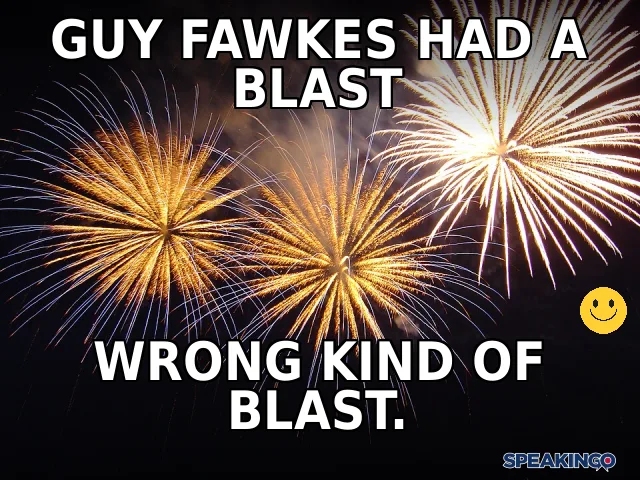
Dad joke? Guy Fawkes really had a blast — but mostly the wrong kind. And that was the end of his plan.

3. Remembrance Day and Remembrance Sunday — a moment of silence and the red poppy
11 November in the UK is Remembrance Day, and the main ceremonies often take place on the nearest Sunday as Remembrance Sunday. It is a day to remember people who died in wars, especially in the First World War, and the symbol is the red poppy, or poppy. GOV.UK and public materials stress the importance of this anniversary and the tradition of a minute of silence.
The language here is more formal:
- remembrance — remembrance, memory
- poppy — poppy
- silence — silence
- memorial — memorial, place of remembrance
- veteran — veteran
Example:
We stood in silence to remember those who died in war.
We stood in silence to remember those who died in war.
On this day, it is not about fireworks, but about quiet and respect. If someone asks whether it is “that November day with poppies,” the answer is yes, but with a very serious meaning.

4. Advent — counting down to Christmas
Advent is not a major public holiday in England, but it is an important time in churches and Christian homes. It is a period of preparation for Christmas. In practice, you see it in Advent calendars, wreaths, and the first decorations. British Council explains that Christmas customs in the UK have Christian roots, but also older winter traditions that became part of modern celebrations.
Vocabulary:
- Advent — Advent
- calendar — calendar
- wreath — wreath
- candles — candles
5. Christmas in England — the tree, stockings, and family chaos
Christmas in England falls on 25 December. It is the most important winter holiday, and 26 December, Boxing Day, is also a public holiday in England and Wales.
Typical British Christmas elements include decorating the home with greenery, sending cards, giving presents, the Christmas meal, and school nativity plays. In many homes, you also see Christmas stockings — special stockings for gifts.
Useful vocabulary:
- Christmas tree — Christmas tree
- stocking — stocking for gifts
- gift — gift
- family dinner — family dinner
- carols — carols
- mistletoe — mistletoe
Examples:
We put the presents in the stockings.
We put the presents in the stockings.
They sing carols every Christmas Eve.
They sing carols every Christmas Eve.
And a Christmas joke? Mistletoe is basically nature’s excuse for awkward romance. You “accidentally” stand under a branch, and suddenly everyone makes a huge deal out of it.

6. Boxing Day — it is not about boxing
26 December in England is Boxing Day. The name has nothing to do with a ring or gloves. It is the day after Christmas, traditionally linked with gifts for servants, workers, and people in need. Today it is mainly a big day for shopping, sport, and family visits. The official bank holiday list confirms that it is a statutory holiday in England and Wales.
Vocabulary:
- sale — sale
- match — match
- to visit relatives — to visit relatives
Example:
We went shopping on Boxing Day.
We went shopping on Boxing Day.
7. New Year and the first days of January
New Year ends this winter sequence of events. In England, there is not one compulsory ritual for everyone, but in many places people watch fireworks, meet family, or simply try to recover from the whole season. In the bank holiday calendar, 1 January is New Year’s Day.
Worth remembering:
- New Year’s resolutions — New Year’s resolutions
- to celebrate — to celebrate
- to recover — to recover

How do you say all this in English?
If you want to describe the whole season, you can say:
In England, the festive season starts with Halloween and ends after New Year’s Day.
In England, the festive season starts with Halloween and ends after New Year’s Day.
People often celebrate Bonfire Night, Remembrance Day, and Christmas in different ways.
People often celebrate Bonfire Night, Remembrance Day, and Christmas in different ways.
Short exercise
Complete the missing word:
- 31 October is __________.
- 5 November is __________ Night.
- 11 November is __________ Day.
- 25 December is __________ Day.
- 26 December is __________ Day.
Answers:
- Halloween
- Bonfire
- Remembrance
- Christmas
- Boxing
Finally: practical English learning with SPEAKINGO
If you really want to get comfortable with this vocabulary, the best way is to practise it in conversation: you listen to questions, answer in full sentences out loud, and train listening, word recall, and fluent speaking. In topics like holidays, customs, and dates, you can clearly see that English lives in conversation, not only in a notebook. On SPEAKINGO, you can practise at your own pace with speech recognition, so instead of just reading about traditions, you really talk about them in English. Create an account in the form below and start speaking about English holidays in English.