
What future forms do we use in English?
In practice, we talk about the future in English with these main forms:
- English future tenses: future simple and future continuous.
- Going to.
- Present continuous.
In short:
1) will if the decision is spontaneous
- future simple: I’ll answer the phone or
- future continuous: I’ll be dancing tonight!
2) going to if we intend to do something (to be going to)
3) present continuous if something is 100% certain: I’m flying to India tomorrow. This means the trip is already fixed, and I have my ticket and packed bags.
For advanced learners, there are also future perfect and future perfect continuous. These are used mainly on English tests, not so much in real communication, so if you want to learn more, see the separate posts about perfect tenses: osobnych wpisów o perfektach.

Future tenses are often signalled by words like:
- in a year
- next week, month
- tomorrow.
Now let’s go step by step.
1a.) How do we form sentences and when do we use future simple?
You could say that only the form with will is the “true” future tense. The future, like the past and the present, has two versions: a simple one and one that puts emphasis on the action in progress (continuous).
The same is true here.
→ Future Simple is very easy. Just add will to a present-tense sentence. For example, if I see you every day, then:
- I will see you.
(See you.)
- Will I see you?
(Will I see you?)
- I won’t see you.
(I won’t see you.)
The same is true for all persons, even he, she, and it:
- She won’t do it.
(She won’t do it.)

The English future simple for spontaneous decisions
We use will mainly to express decisions made on the spot, during the conversation. For example, the phone rings, so I answer:
- I’ll pick it up.
A terrible dragon has flown into our kingdom:
- I’ll kiss it!
…says the knight, looking at the princess, and so on.
If it is a firm decision, we use the full form will instead of the short form ‘ll to stress it strongly:
- I will never drink again.
(I will never drink again.)

The future simple can also be used to express opinions, for example:
- He’ll be rich one day
(One day he will be rich.)
We can also use future simple to make promises:
- I won’t do it again, mum.
(I won’t do it again, Mum.)
With future simple we can also talk about things we cannot control:
- It’ll rain next week.
(It will rain next week.)
Read more about future simple in this post:

1b) How do we form and use future continuous?
Future continuous, like all continuous forms, puts emphasis on an action in progress.
- I will be dancing tonight.
(I will be dancing tonight.)
- She won’t be dancing tonight.
(She won’t be dancing tonight.)
- Will you be dancing tonight?
(Will you be dancing tonight?)
Future continuous describes actions that will be happening at a specific moment in the future. In the sentences above, that moment is tonight (tonight).
Read more about future continuous in this post:

2) The to be going to structure
When we plan something, but the plan may still change, we usually say I’m going to do something. You could say this is the English equivalent of “I intend to”. I want to do it, but it is not certain yet — 50/50, or fifty-fifty, as Americans say.
In general, we use the short form of the verb to be, in the form that matches the subject. It may sound complicated, but it is actually quite simple:
- I’m going to see her mother.
(I am going to meet her mother: ‘m is the short form of am)
- She’s going to marry him.
(She wants to and plans to marry him: ‘s is the short form of is)
- They’re going to move houses.
(They are going to move house: ‘re is the short form of are)
- I’m not going to speak to her again.
(I am not going to speak to her again.)
- Is he going to jump?
(Is he going to jump?)

We also use to be going to to make future conclusions based on what we observe, for example:
- She eats too much – she’s going to get fat!
We will usually not use this structure if we want to talk about going somewhere (to go), because I’m going to go there is technically correct, but it sounds rather odd.
There are many nicer verbs we can use instead of to go:
- to walk (to take a walk),
- to stroll (to go for a stroll),
- to run (to run),
- to rush (to hurry),
- to visit (to visit)…
Read more about to be going to (gonna) in this post:

3) Present continuous for the future
We already met this third option in the post about English present tenses. It is the use of present continuous for the future when something is 100% certain. For example, if we have already bought tickets for the plane and nothing will stop us from our planned holiday, then, just like in Polish, we use the present tense as if it were already happening:
- I’m flying to the USA tomorrow.
(I’m flying to the USA tomorrow.)
- We’re not going there any time soon.
(We are not going there any time soon.)
- Is she moving to the UK?
(Is she moving to the UK?)
As I mentioned, this is not difficult; it only sounds complicated (present continuous for future arrangements). In English, we do exactly the same thing: we can say, “I’m flying to the USA tomorrow,” rather than “I will fly to the USA tomorrow.”
Read more about this use of present continuous (and even present simple) for the future in the post:
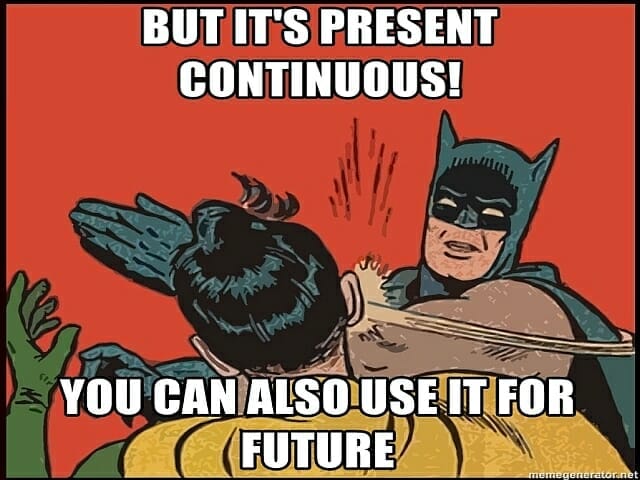
The same idea can be expressed with the two forms above as well.
- I’ll fly to the USA if I have just made this important decision.
- But I’ll say I’m going to fly to the USA if I want to, if I intend to, but there is a chance that even though we mean well, things may still go as usual…
Believe it or not, that’s all there is to it!
And where you are, do you need English future tenses?
English means better-paid and more interesting work. English is good for your health, especially for your brain. English gives you freedom to travel, learn, gain experience, and meet new people.
English is the future!
On the Speakingo English course, you learn quickly and enjoyably through speaking English… with your phone or computer, which understands you, praises you, and corrects you when needed. No stress, no travel, whenever you want and for as long as you want. And one month of learning costs as much as one private lesson!
Of course, the best way is to try it for free and without obligation. Register in two clicks below and see whether this modern way of learning English online works for you!
Do you want to practise English future tenses in real use?
Sign up for the Speakingo online English course!
It is not as hard as it seems, is it? Share your opinions or questions about English future tenses, future simple and future continuous, the going to structure, or present continuous used for the future in the comments!
If this text made things clearer, share it with your friends!