In this post, you will learn English for travel in a truly useful version: at the airport, in a hotel, in a restaurant, on a train, and when you need to ask for directions. No fluff, just examples you can repeat out loud right away. Because on a trip, what helps most is not knowing the finer points of present perfect continuous passive, but being able to say: “Is this the right platform?” or “Where can I leave my luggage?”.
1. The most important phrases to start with
Let’s begin with a few sentences that save the day more often than a power bank:
- Excuse me, where is…? — Przepraszam, gdzie jest…?
- Could you help me, please? — Czy mógłby mi Pan / Pani pomóc?
- I’m looking for… — Szukam…
- How much is it? — Ile to kosztuje?
- Can I pay by card? — Czy mogę zapłacić kartą?
- Could you say that again, please? — Czy mógłby Pan / Pani powtórzyć?
- I don’t understand. — Nie rozumiem.
- Could you speak more slowly, please? — Czy mógłby Pan / Pani mówić wolniej?
These are phrases that work in almost any situation. British Council points out that it is worth learning useful phrases for specific situations and practising them in real life instead of just reading them. That is very good news for everyone who prefers speaking to endless “going through the material”.
2. At the airport and on the plane
The airport has its own language, and sometimes it sounds like a secret code for people with suitcases. Luckily, you only need a few words. Cambridge says that luggage means baggage, that is, bags, suitcases, and other things we take on a trip; in British English, it is a very natural word. ([dictionary.cambridge.org](https://dictionary.cambridge.org/us/dictionary/english/luggage?utm_source=openai))
- Where is the check-in desk? — Gdzie jest stanowisko odprawy?
- Where is the security check? — Gdzie jest kontrola bezpieczeństwa?
- Where is the departure gate? — Gdzie jest bramka odlotów?
- My luggage is missing. — Mój bagaż zaginął.
- My flight is delayed. — Mój lot jest opóźniony.
- Where can I collect my luggage? — Gdzie mogę odebrać bagaż?
- Is this the right gate for flight…? — Czy to właściwa bramka dla lotu…?
On the plane, this may also be useful:
- Could I have some water, please? — Czy mogę prosić o wodę?
- Could I change my seat? — Czy mogę zmienić miejsce?
- Where is the lavatory? — Gdzie jest toaleta?
If you want to sound polite, could I and could you are a safe choice. When travelling, politeness often works better than nervously waving your boarding pass like a victory flag.
3. In a hotel and for an overnight stay
A hotel is a place where you finally want to rest, and then suddenly you have to talk. So it is good to have a few simple sentences ready:
- I have a reservation. — Mam rezerwację.
- I’d like to check in. — Chciałbym / chciałabym się zameldować.
- I’d like to check out. — Chciałbym / chciałabym się wymeldować.
- What time is breakfast? — O której jest śniadanie?
- Could I have an extra towel, please? — Czy mogę prosić o dodatkowy ręcznik?
- The air conditioning is not working. — Klimatyzacja nie działa.
If you need to leave your luggage, you can say:
- Can I leave my luggage here? — Czy mogę tu zostawić bagaż?
- Is there a luggage room? — Czy jest przechowalnia bagażu?
It is worth remembering that luggage is very useful in hotels and at airports. Cambridge describes it as baggage taken on a trip, and British English especially likes this word.
4. In a restaurant and café
When you travel, food can be just as important as sightseeing. Sometimes even more important, because after a whole day of walking, a person suddenly discovers that they are not a camel. So this will come in handy:
- A table for two, please. — Stolik dla dwóch osób, proszę.
- Could we have the menu, please? — Czy możemy prosić o menu?
- What do you recommend? — Co Pan / Pani poleca?
- I’m vegetarian. — Jestem wegetarianinem / wegetarianką.
- Can I have the bill, please? — Czy mogę prosić o rachunek?
- Could we get some tap water? — Czy możemy prosić o wodę z kranu?
The word bill can also be useful in a British restaurant. In the USA, you will more often hear check. When travelling, it is good to know both, so you do not end up with a bill in your eyes instead of on the table.

5. Asking for directions
Phone navigation helps, but sometimes you are still standing still and looking at a map as if it were a work of modern art. Then basic phrases for asking for directions come in handy. In its materials on communication in English, the British Council encourages practising these short, practical dialogues. ([learnenglish.britishcouncil.org](https://learnenglish.britishcouncil.org/free-resources/speaking?utm_source=openai))
- Excuse me, how do I get to the station? — Przepraszam, jak dojść na dworzec?
- Is it far from here? — Czy to daleko stąd?
- Should I go left or right? — Powinienem iść w lewo czy w prawo?
- Is it within walking distance? — Czy da się tam dojść pieszo?
- Could you show me on the map? — Czy mógłby mi Pan / Pani pokazać na mapie?
If someone answers:
- Go straight ahead. — Prosto przed siebie.
- Turn left. — Skręć w lewo.
- Turn right. — Skręć w prawo.
- It’s next to the bank. — To jest obok banku.
- It’s opposite the station. — To jest naprzeciwko stacji.
These are exactly the kind of ready-made language chunks that stay in your head best. Then you do not need to build a sentence like a piece of furniture from instructions that lost half the screws.

6. On the train, bus, and taxi
Public transport is a travel classic. Sometimes comfortable, sometimes a little chaotic, but always worth a few phrases:
- Is this seat free? — Czy to miejsce jest wolne?
- Which platform does the train leave from? — Z którego peronu odjeżdża pociąg?
- Does this bus go to the city centre? — Czy ten autobus jedzie do centrum?
- How long does it take? — Ile to trwa?
- Could you stop here, please? — Czy mógłby Pan / Pani zatrzymać tutaj?
- Take me to this address, please. — Proszę zawieźć mnie pod ten adres.
It is also worth knowing the basic word travel. Cambridge defines it as going from one place to another, usually over a long distance, and also the act of travelling itself.

7. Mini travel vocabulary
Here is a small set of words that often come up when travelling:
- airport — lotnisko
- station — dworzec / stacja
- platform — peron
- gate — bramka
- reservation — rezerwacja
- ticket — bilet
- map — mapa
- direction — kierunek
- tourist information — informacja turystyczna
You do not need to know everything at once. When travelling, the “little but often” method works best — and definitely out loud.
Exercise: answer in a full sentence
Try saying the answers out loud in English. Not in one word, but in a full sentence.
- Where is the lavatory?
- Could I have some water, please?
- I’d like to check in.
- How do I get to the station?
- Does this bus go to the city centre?
Answers:
- Where is the lavatory?
- Could I have some water, please?
- I’d like to check in.
- How do I get to the station?
- Does this bus go to the city centre?
Why does it work?
Because when you travel, you do not need poetry — you need automation. When you learn whole sentences, it is easier to reproduce them in a real situation later. The British Council and communication-learning materials regularly stress the value of practising specific phrases in context, not just dry vocabulary lists.
So if you want to turn passive knowledge into real speaking, practise out loud: listen to the question, answer in a full sentence, correct yourself, and repeat. That kind of practice builds confidence faster than looking at someone else’s notes and hoping the language will “install itself”.
A small meme joke to finish
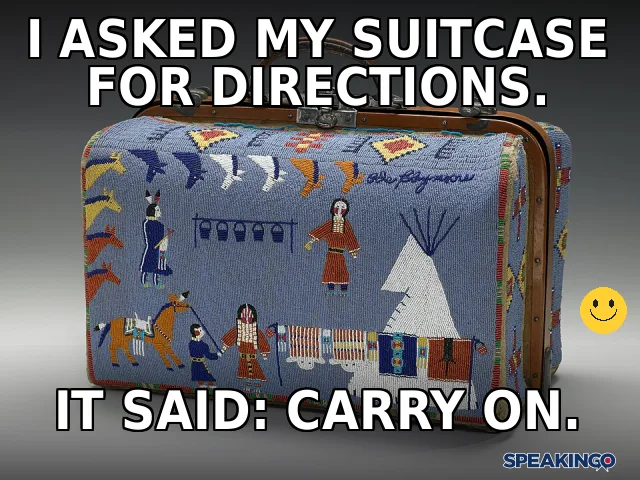
I asked my suitcase for directions.
It said: carry on.
Joke explanation: Carry on means “continue” or “go on”, and a carry-on is hand luggage. So the suitcase gives travel advice and also talks about itself. At least it did not tell you to turn left into the luggage hold.
Practise travel English with SPEAKINGO
If you want to really use these phrases in conversation, practise them in action: listen to questions, answer in full sentences out loud, get comfortable with the vocabulary, and train your understanding at your own pace. Learning through conversation helps break the block, because you practise speaking right away, not just “knowledge about English”. Register in the form below and start preparing for your trip before you leave.