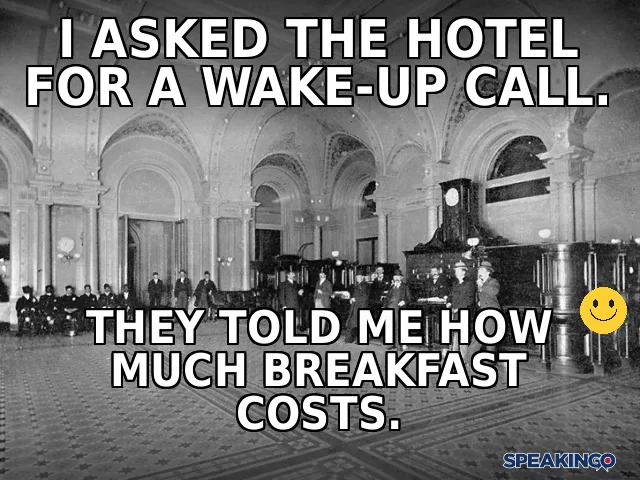
The hotel in the photo had a sea view. From the window, you can see a parking lot, and the shower has the temperature of the Baltic Sea in February. Before you start communicating with the reception desk by mime, learn English at a hotel. It will help you from booking to check-out.
You do not need a speech. A few simple sentences are enough to say what you need and to ask again when you do not understand something.
Booking a room in English
A booking is a booking or a reservation. If you call a hotel, you can start with:
I’d like to book a room for two nights.
I would like to book a room for two nights.
Do you have any rooms available for Friday night?
Do you have any rooms available for Friday night?
It is also good to ask about beds. A double room usually means a room with one double bed, and a twin room means a room with two separate beds. But hotel names can be different, so it is best to ask directly:
Does the room have two separate beds?
Does the room have two separate beds?
Meals are another important point. Is breakfast included? means “Is breakfast included?”. This is a more useful question than finding out in the morning that coffee costs as much as last night’s dinner.
Check-in: I have a reservation
At reception, a simple sentence is enough:
Hello. I have a reservation under the name Kowalski.
Hello. I have a reservation under the name Kowalski.
The phrase under the name means “with the surname/name”. You do not need to explain your whole family tree to the receptionist. If your surname is hard to understand, you can offer: Shall I spell that? — “Shall I spell that?”.
Check in means to arrive and register at the hotel, and check out means to leave. Cambridge explains that a verb can be two words, while a noun can have a hyphen, as in the question What time is check-in? — “What time is check-in?”.
Do not assume that one time is the same everywhere. Also ask: What time is check-out? — “What time do I have to check out?”.
Reception dialogue in English
Guest: Hello. I have a reservation under the name Kowalski.
Guest: Hello. I have a reservation under the name Kowalski.
Receptionist: Welcome. Could I see your ID, please?
Receptionist: Welcome. Could I see your ID, please?
Guest: Of course. Is breakfast included?
Guest: Of course. Is breakfast included?
Receptionist: Yes. Breakfast is served from seven to ten.
Receptionist: Yes. Breakfast is served from seven to ten.
Guest: Thank you. What time is check-out?
Guest: Thank you. What time is check-out?
Receptionist: By eleven. Your room is on the second floor.
Receptionist: By eleven. Your room is on the second floor.
This is only an example conversation, not a rule for every hotel. In British English, the ground floor is the floor at street level, and the first floor is the next floor above it. In the USA, the ground floor is often called the first floor. Checking the room number will be easier than an international argument about floor counting.
Deposit, extra charge, or already paid?
If you see an unclear amount, you do not need to pretend that you understand everything:
- I’ve already paid online. — I’ve already paid online.
- Is this a deposit or an extra charge? — Is this a deposit or an extra charge?
- Will the deposit be refunded? — Will the deposit be refunded?
- Could you explain this charge, please? — Could you explain this charge, please?
A deposit can mean an advance payment or a security deposit, depending on the situation. If it is a card hold, you may hear a hold or a pre-authorisation. Ask about the rules for your specific booking; the word alone does not tell you when you will get your money back.
How do you report a problem in the room?
You do not need to know plumbing to say:
The shower isn’t working.
The shower isn’t working.
There’s no hot water.
There is no hot water.
My key card isn’t working.
My key card isn’t working.
The room is very noisy.
The room is very noisy.
Add a polite request: Could someone take a look, please? — “Could someone check it, please?”. The structure Could you…? is very useful outside the hotel too.
Second dialogue: the shower decided to take a day off
Guest: Hello. I’m in room 204. There’s no hot water.
Guest: Hello. I’m in room 204. There’s no hot water.
Receptionist: I’m sorry about that. We’ll send someone up.
Receptionist: I’m sorry about that. We’ll send someone up.
Guest: Thank you. How long will it take?
Guest: Thank you. How long will it take?
Receptionist: About fifteen minutes.
Receptionist: About fifteen minutes.
Guest: If it can’t be fixed, could I change rooms?
Guest: If it can’t be fixed, could I change rooms?
You do not need to speak quickly. If you do not understand the answer, say Could you say that again more slowly, please? — “Could you repeat that more slowly, please?”. This is a real communication tool, not an admission of failure.
Check-out and luggage storage
Before you leave, you can say I’d like to check out, please. — “I’d like to check out.” You may also need:
- Could I have a receipt, please? — Could I have a receipt, please?
- Can I leave my luggage here until this afternoon? — Can I leave my luggage here until this afternoon?
- Is late check-out available? — Is late check-out available?
- Is there an extra charge? — Is there an extra charge?
After the hotel adventure, it is time for the next part of the trip. You can review English at the airport or a restaurant dialogue.
Exercise: what would you say in this situation?
First try to answer out loud, and only then look at the suggested answers:
- You have a reservation under the name Nowak.
- You want to check whether breakfast is included.
- There is no hot water in the room.
- You want to leave your luggage until the afternoon.
Sample answers:
- I have a reservation under the name Nowak.
- Is breakfast included?
- There’s no hot water in my room.
- Can I leave my luggage here until this afternoon?
These are not the only correct sentences. If you said the same thing in different words, that is also great: at reception, communication matters more than guessing the answer key.
Hotel joke from a meme: wake-up call
I asked the hotel for a wake-up call. They told me how much breakfast costs.
“I asked the hotel for a wake-up call. They told me how much breakfast costs.” A wake-up call can mean a literal phone call to wake you up, but also something that makes you see an unpleasant reality. In this joke, the price wakes the guest up more effectively than a phone call.
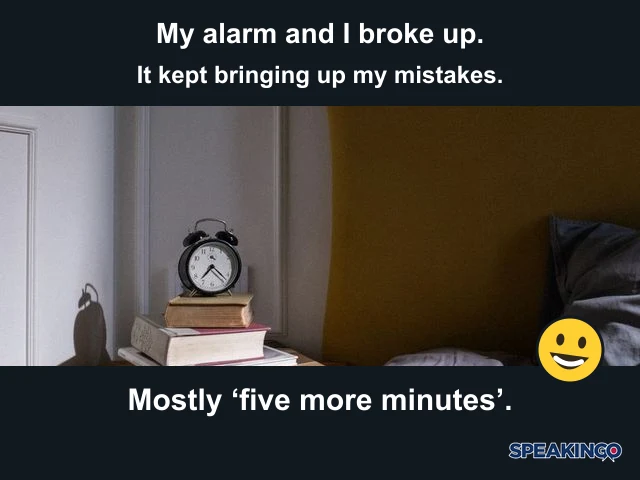
Not every hotel offers this service. Luckily, your phone alarm usually does not add a service charge.
Before you travel, practise speaking on SPEAKINGO
Reading phrases helps you recognise them. Answering questions out loud helps you check whether you can recall them when you need them. It is worth combining both before you are tired from travelling, standing at reception, and the words refuse to come out!
On SPEAKINGO, you practise English by listening and answering in full sentences. Thanks to speaking practice, you do not stop at recognising words in a table. Start at your own pace, and say the sentences from this article with your own surname and your own travel plans too.
Do you want to use English more freely in everyday situations? Sign up for the SPEAKINGO course in the form below and start practising conversation.